
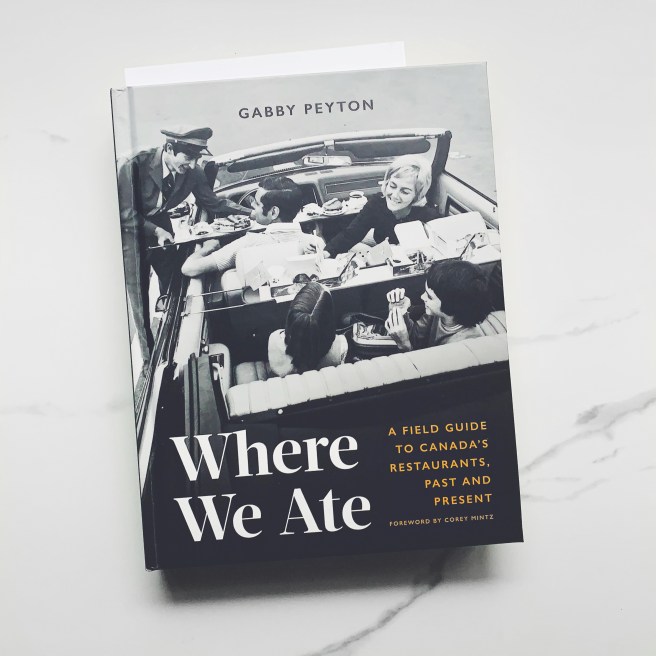
Why is it that when I think of all the places I have lived in or visited across Canada, the first thing that comes to mind are the restaurants? I think it’s what Gabby Peyton tells us in the introduction to her book, Where We Ate: “Restaurants are so much more than the iconic food they invent or best-of lists they make. They are a combination of the people who operate them, the atmosphere they create and the food they serve. Restaurants are nothing without the people who run them and the people who eat there. The families, the friends, the diners – it’s all a community.” (3) And it’s in these micro communities that, when put together, weave the fabric of a place — indelible in our memories. So, it’s no wonder that when I think of the cities I’ve enjoyed, the restaurants stand as a symbol representing much more than food, and, as Peyton further explains, “The story of Canadian restaurants tells a broader story of the country.” (5)
Peyton’s book is organized chronologically by decade (starting with Before Confederation to The 2010s) with a handful of restaurants populating each one. Should readers and restaurant enthusiasts wonder if she mentions all the restaurants? No! I don’t think Peyton needs to because what her book offers are snapshots of the Canadian culinary scene – a true “love letter” to all the places or types of places we’ve all eaten at. Peyton’s account of the restaurants she mentions are informative, interesting, and, often poignant. Her choices aren’t precious either – she’s done such an excellent job of offering readers a useful cross-section of restaurants. Some immediately recognizable – Tim Horton’s or Boston Pizza – to ones that are very specific to a city like King of Donair (in Halifax) or The Naam (in Vancouver). Some of the restaurants are still in operation while others are not. Peyton has also done her best to include a diverse selection of places but notes in her introduction different reasons for any omissions or gaps – “a lack of record keeping by small business owners, biased census takers or racist business practices which would have obstructed minorities from owning businesses or finding employment.” (6)
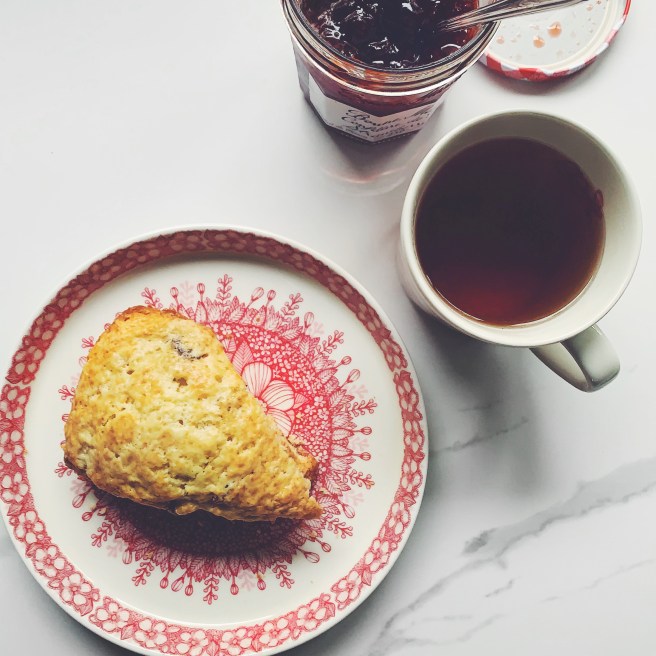
I appreciate how the book is designed – for each restaurant entry there are a few paragraphs going into the story/history/food behind it. At times there are accompanying photographs or ephemera (menus, illustrations, etc.) and she also shares some corresponding recipes too. When discussing the Canadian Pacific Hotels, she shares the recipe for Signature Raisin Scones from the Fairmont Empress Hotel in Victoria, British Columbia. I baked this recipe for my daughter one rainy weekend here and we enjoyed them with tea and strawberry jam. I am unsurprised that this recipe has been in use at the Empress since 2000 because the scones are deliciously tender and smell a little like shortbread cookies as they bake in the oven.
Through her carefully crafted narrative, Gabby Peyton (restaurant critic and food writer) has constructed a touching historiography of the restaurant landscape in Canada. While we can never fully know a restaurant experience if we’ve never been there, as Corey Mintz says in the forward to Where We Ate, Peyton’s book shows “…us how each era of dining, along with the influences of culinary and immigration trends, flowed into the next.” (1) From here, readers are given the opportunity to vicariously enjoy these places who fed and nourished so many.
I would like to take this opportunity to thank Appetite by Random House for providing me with a free, review copy of this book. I did not receive monetary compensation for my post, and all thoughts and opinions expressed are my own. Any links provided are intended purely for informational purposes.

 Shipshape Eatworthy